
Disclosure: I implement Zoho CRM for a living, so I have a commercial interest in this question. Where the evidence goes against that interest, I say so.
My short answer: most small businesses should not replace their whole CRM with an AI-built one yet. Keep customer data in a CRM with permissions, audit logs, and backups, and use AI to build the small tools around it. A full replacement can make sense for one small team with simple needs and someone who can maintain it every month.
What business problem are you trying to solve?
Start here, because "replace the CRM" is a solution, not a problem. These are the problems I would separate first, with my own suggestion for each.
| The problem you have | What to try first | When replacing makes sense |
|---|---|---|
| You pay for seats and features nobody uses | Reduce seats or change plan | You use only a small part of the product |
| Salespeople do not enter data | A simple mobile tool that captures notes and writes back to the CRM | The team is very small and the CRM adds nothing else |
| Customization quotes feel too high | Ask for a fixed price and a smaller scope | The change is outside what the CRM can do |
| One process does not fit the CRM | Build one small tool at the edge | That process is almost your whole business |
| Reports do not answer your questions | Clean the data first, then add a dashboard | Rarely. A new system will not fix bad data |
If your problem is in the middle column, you may not need a new system at all. If you are not sure the data is ready, this CRM record readiness check is a practical place to start.
Why is this question coming up now?
Because the question has reached CRM vendors too. In October 2026, Business Today reported on an internal Zoho email accessed by ET Now. According to that report, Zoho Chief Scientist Sridhar Vembu wrote that Zoho is still growing at 12%, that growth slowed more than expected in September, and that some customers are choosing AI-built alternatives. Business Today
The report does not say how much of the slowdown comes from those customers. In a separate public post, Vembu pointed to rising AI costs, higher server prices, and geopolitics as pressures on the business. Zoho Corporation also announced 20% revenue growth for 2025 and more than one million paying customers across its products. I read this as a question for the whole software industry rather than a sign of trouble at one vendor. Zoho Corporation press release
To go further, I reviewed public case reports, security research, and job posts visible on Upwork on 30 October 2026. The job posts are a snapshot, not a statistic.
Can AI really replace a CRM?
For small, simple cases, yes. For the system that holds your core customer records, the evidence is much thinner.
Small, low-risk tools are the easiest place to start. On 30 October, I saw Upwork posts asking to rebuild a WordPress site as static pages and to replace a spreadsheet-based order system with a small web application.
Some small firms have gone further. Kyle Burt, founder of the technology advisory firm Catch Advisors, built a tool to run the firm's marketing and sales. Channel Dive reports that it replaced $1,200 a month in subscriptions, including a former CRM. Burt's reasoning was direct: "People in our business only need like 20% of what HubSpot can actually do." Channel Dive
The large CRM stories are still early stories. One reported case is Curative, a US health insurer. Salesforce Ben, a publication that covers the Salesforce ecosystem, reports that founder Fred Turner told a podcast the company cancelled a $600,000 Salesforce contract after building a CRM with AI in two months. Turner said the new system works better and that the effort is worthwhile for most businesses of reasonable scale. Turner also said, "The maintenance is definitely one of the most challenging pieces." Salesforce Ben
These are the company's own statements. In the public cases I reviewed, I did not find how long the new system had been running, or an independent follow-up on the results.
The one follow-up I did find is useful. In August 2024, Klarna's "shut down Salesforce" remark became a widely repeated story. In March 2025, its CEO corrected the record: "we did not replace SaaS with an LLM." Klarna had consolidated its data and moved to other tools, including other SaaS products. CX Today
The core record often stays. SaaStr, a SaaS media company, runs more than 20 AI agents in production but says Salesforce remains its system of record: "We did not vibe code our own CRM." SaaStr
How much does an AI-built CRM really cost?
The first version is cheap. The cost that decides the answer comes later.

What $500 buys. One Upwork post I read on 30 October asked for an AI sales application with accounts, contacts, visit logs, and a pipeline. The target budget for a first release was $500. The poster, a sales manager who is not a programmer, had already planned the product with ChatGPT and did not want to pay for a long discovery phase. About a day after posting, the job showed 80 proposals, with a median bid of $500 and a high bid of $3,900.
The rest of the post is more interesting. The company's official CRM stays as the system of record, and the new application must work alongside it rather than become a second CRM. In the $500 version, CRM, AI, and email workflows may be simulated if they are clearly labeled. The post also accepts that complex integrations, security changes, and production failures may still need professional support.
That is an honest buyer. The $500 buys a first version. It does not buy the next three years.
What the next three years cost. In Facts and Fallacies of Software Engineering, Robert Glass puts maintenance at 40 to 80% of software cost. Review of the book Those numbers predate AI coding tools, and AI may lower the hours. Nobody yet has several years of data on AI-built CRMs.
Here is a simple way to test your own case, using two numbers from the Channel Dive report above. One firm saved $1,200 a month. Separately, the report quotes this estimate of the work involved: "at least 160 hours, and then continuously 40 hours a month." The two numbers may not describe the same firm.
If both applied to you, you would save $14,400 a year and spend 480 hours a year. The saving disappears once that time costs more than $30 an hour, before counting the first 160 hours. This is an illustration from one report in one industry, not a benchmark. Replace the numbers with your own.
| Cost to include over three years | What to ask |
|---|---|
| First build | What exactly is included, and what is simulated? |
| Maintenance | Who has the hours each month, and at what cost? |
| Hosting and AI usage | What are the monthly bills once real users start? |
| Migration | Who moves and cleans the existing data? |
| Security review | Who checks permissions before customer data goes in? |
| Failure | What does one day of downtime cost your sales team? |
The work can also grow with use. A second Upwork post from 30 October came from a software company that says its CRM data-sync platform was built with Claude. Volume has grown, the pipeline cannot keep up, and the company is hiring a senior engineer. The work list includes an audit log, narrower API key permissions, and conflict detection when two systems update the same record. In my reading, these are typical second-year items.
What could this look like in practice?
The two stories below are fiction based on real projects. I changed the companies, industries, tools, and numbers so that no real company can be identified. Please read them as illustrations, not as evidence.
Story 1: a billing application built with AI coding tools. A regional wholesaler sends monthly invoices to its customers. Its old process relies on a no-code automation tool and a shared database. The owner decides to replace it with a custom application, built mostly by AI coding tools, with a person checking the work. The first screens appear within days, and everyone is impressed.
Months later, the work is still going. Hundreds of small changes have been made. The new application still runs next to the old accounting software, because nobody wants to risk a wrong invoice.
Then a problem appears that testing did not catch: saving an invoice sometimes fails. The hosting plan limits the database calls allowed per request, and the save action needs slightly more than that. It only fails under certain conditions, so it looks random. The team reduces the calls, and now has to measure them whenever the application changes.
The owner keeps two rules. Invoices stay as drafts until a person approves them, and every release starts with a backup that has been checked.
Story 2: a read-only AI connection. A company wants AI to answer questions from its CRM and help desk. Instead of building a new system, it connects AI tools through the vendor's MCP servers. The tools are read-only, each use needs authorization, and activity is logged. The CRM stays the system of record, and AI can look things up without being able to change a record through that connection.
In both stories, AI reaches a first version quickly. It does not remove testing, release steps, or the need for someone to be responsible when something fails.
Is an AI-built CRM secure enough for customer data?
It can be, but do not assume it. A CRM holds customer names, email addresses, phone numbers, and deal history, so the question deserves a real review.
Veracode, a security vendor, says in its 2026 report that AI models averaged a 56% security pass rate, virtually unchanged from the previous year. It tested raw models with no security instructions, not agents or production setups with extra guardrails and human review. So this number does not describe every AI-built application, but it shows why generated code needs review. Veracode release via SD Times
Two public cases from 2025 show the kinds of risk involved. The first is missing rules about who can see which record: a security researcher reported scanning 1,645 Lovable projects and finding insecure endpoints on 170 of them, linked to row-level security settings. SecurityOnline The second is an AI agent with too much access: an investor building an application on Replit reported that its agent deleted the production database during a code freeze, and Replit's CEO responded with a promise of fixes. TechTarget Both tools may have changed since then, so I treat these as examples of the risk, not as a verdict on either product.
Accountability stays with you. You are responsible for your customers' data whichever system you use. With a commercial CRM, you also have a vendor, a contract, and a security team for the platform. With your own application, all of that work is yours. Where GDPR applies, a reportable breach generally has to go to the regulator within 72 hours where feasible. In Japan, a leak of personal data that may involve unauthorized access needs a preliminary report within three to five days of discovery, whatever the number of people affected. Check the rules in your own country.
Should you build, keep, or combine?
Most small businesses will land on combining the two. These are my own rules of thumb, not research findings.
| Building with AI fits when... | Keeping a commercial CRM fits when... |
|---|---|
| One small team uses it | Several teams or many users share it |
| The data is low-risk | It holds customers' personal data |
| A day of downtime would be annoying | A day of downtime would stop sales |
| Someone on your team can maintain it | Only the person who built it understands it |
| You use a small part of a large product | Your process depends on reports, permissions, and audit trails |
The pattern I recommend is to keep the system of record and build at the edges. A system of record is the one place your business treats as the official version of the data.
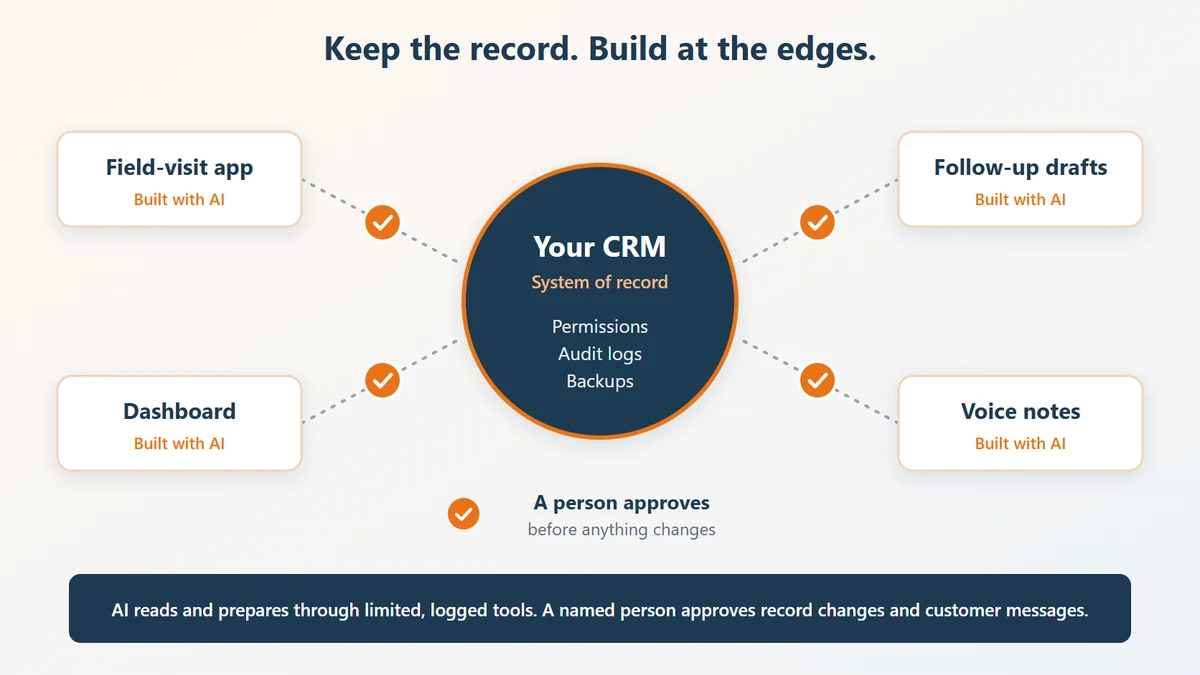
Keep customer data in the CRM. Then use AI to build the small tools around it, such as a field-visit application, a dashboard, or an assistant that drafts follow-up emails. Zoho CRM, HubSpot, and Salesforce all publish documentation for connecting AI tools through the Model Context Protocol (MCP).
Keep one boundary clear. AI can read and prepare through limited, logged tools. A named person should approve changes to customer records, bulk updates, and messages sent to customers. For the fields this depends on, see this guide to AI-ready CRM records.

How should you pay for CRM implementation now?
Pay for decisions and results where you can, rather than for hours of configuration.
You may be wondering whether implementation partners are already earning less. I could not find public figures that show this for Zoho partners. Overall spending is not falling yet either. What I did find is pressure on how this work is priced.
A Financial Times report republished by The Irish Times cites a Source Global estimate that clients will spend $420 billion on technology consultants this year, up 8%, including $236 billion on implementation. The same report says the shift is not yet obvious in industry revenues. It also says SAP claims planned changes could cut external consultant costs by up to 50%, while Capgemini's CEO responded, "We don't see 50 per cent." Bristol Myers Squibb has pressed its advisers to lower costs or move from hourly billing to fixed-price or performance-related fees. The Irish Times Salesforce has also overhauled its partner program, in what the research firm Futurum describes as rewarding "verified outcomes rather than logged hours." Futurum
My interpretation is that the shift is not "SaaS is dead." Paying by the hour to configure fields and write scripts is what is coming under pressure. Lower prices may also bring customization within reach of companies that could not afford it before.

How can you build around Zoho CRM?
I have worked on building and customizing Zoho for more than three years, and I also implement with AI.
Zoho has a feature called widgets, which gives you a lot of flexibility in what you design and build. You can connect an application through APIs and place it inside Zoho. You can also build an application on Zoho Catalyst, or on your own Azure or AWS environment.
Whichever you choose, connect it to the CRM as your system of record. From there, what matters most is how you turn those records into action.